

 महात्मा गांधी जलवायु परिवर्तन रोकथाम संस्थान



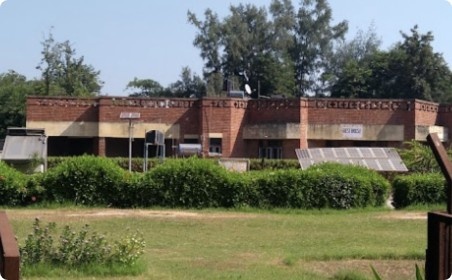
Mahatma Gandhi Institute for Combating Climate Change is an autonomous institute under Government of NCT of Delhi. It was established by the Planning Commission in 1990 in collaboration with Government of NCT of Delhi as Centre for Integrated Rural Energy Planning (CIREP) at Bakoli, Alipur, Delhi under Integrated Rural Energy Programme (IREP). It was intended to function as a national level training and research institution.
During 1992 it was constituted as an autonomous institute (registered as a society under Societies Registration Act, 1860) called Delhi Institute for Integrated Rural Energy Planning and Development.
It was subsequently renamed as Mahatma Gandhi Institute for Integrated Rural Energy Planning and Development and dedicated to the nation on 02.10.1992 by Hon’ble Prime Minister.
The institute was transferred to Govt. of NCT of Delhi in 2007-08 after IREP was discontinued and it is now fully funded by grants received from GNCTD.
The Institute was renamed as Mahatma Gandhi Institute for Combating Climate Change (MGICCC) in 2009 with mandate to organise training programs for Government, Public Sector and Private Sector officials in climate change and related areas and to conduct actionable research in key areas like pollution control, waste management, bio-diversity, greening, energy efficiency, renewable energy, climate change and clean development mechanism, etc.
Mission:
MGICCC envisions itself as an inhouse resource providing quality services to Government of NCT of Delhi in combating climate change with focus on developing science-based solutions to identified challenges and assisting in their implementation.
Objectives:
MGICCC is mandated to organise training programs for Government, Public Sector and Private Sector officials in climate change and related areas and to conduct actionable research in key areas like pollution control, waste management, bio-diversity, greening, energy efficiency, renewable energy, climate change and clean development mechanism, etc.
In the long-term, MGICCC aspires to establish itself as a national level research and educational Institute focused on research, education and training, and consultancy in areas of environment, ecology, and climate change, in the context of urban sustainability, and to serve as a “think tank and knowledge partner” for the Government for evolving policies, regulations, and investment programs for urban sustainability and knowledge management.
MGICCC identifies Energy and Power, Urban Planning, Pollution, Water, Forests and Biodiversity, Transport, Agriculture and Horticulture, Disaster Management and Strategic Knowledge as key areas for priority attention in the short-term.